

 Image 1 of 1
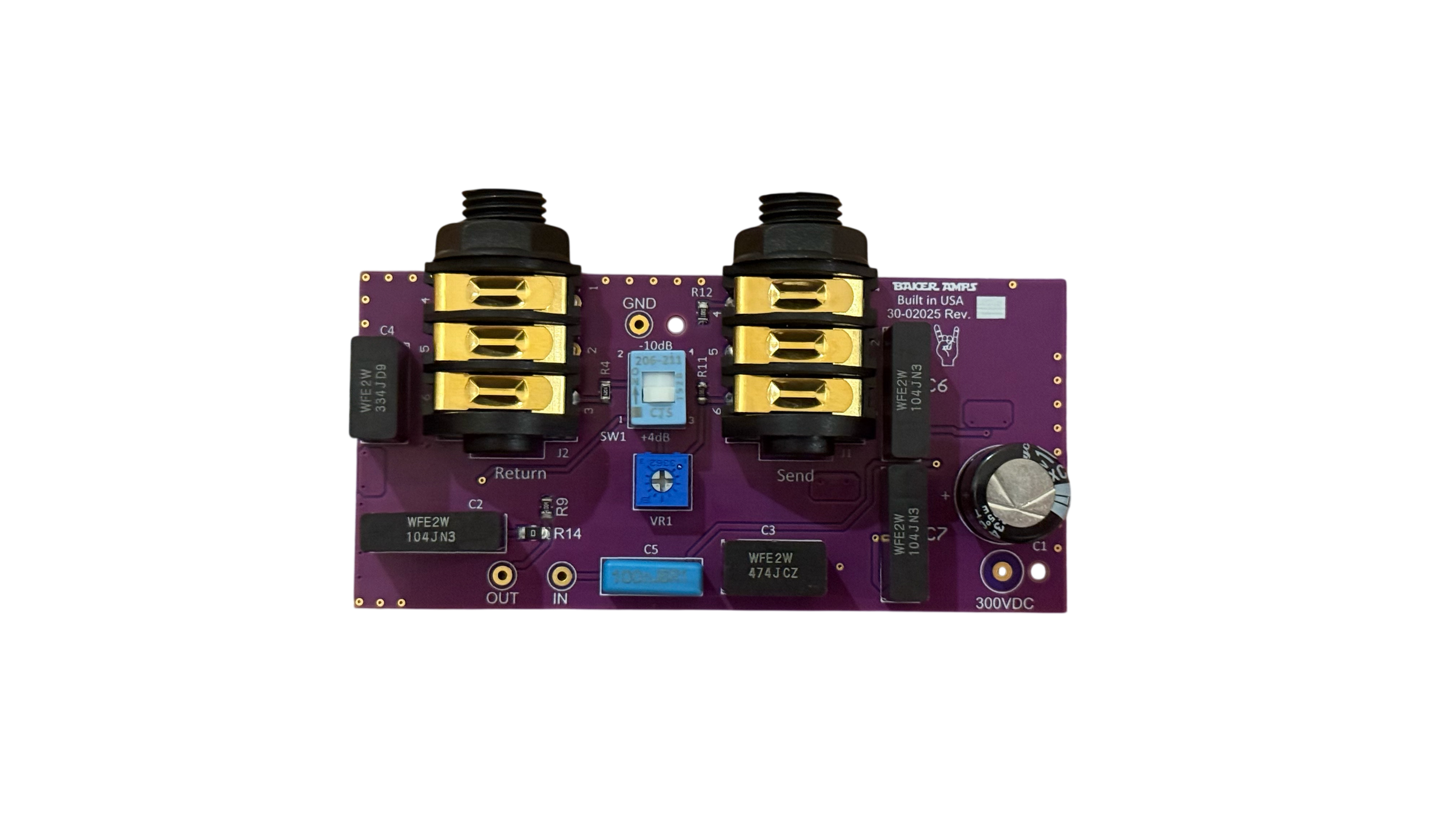
The new Baker Amps Studio FX Loop is an updated take on the widely used LND150 FX loop design.
The original LND150 loop is one of the most popular FX loop circuits used by amplifier builders. However, the design has a technical performance limitation: its preamp signal level is approximately 60 mV RMS, which is significantly lower than a proper instrument-level signal. Because it delivers such a weak signal, the Return stage must apply substantial gain to bring it back up to a respectable level. This creates problems for players who want to slave other amplifiers or connect additional effects, as excessive recovery gain can affect the tone and sound quality of their equipment. Ultimately, this limits the ability to take full advantage of an FX loop's capabilities.
The −10 dBV and +4 dBu settings also fail to deliver their intended output levels. Rather than providing true line-level output, the original design only raises the signal to approximately 220 mV RMS, falling well short of the 1.10 V RMS expected from a proper +4 dBu line-level signal.
The new Baker Amps Studio FX Loop corrects these signal-level limitations. It delivers a properly calibrated instrument-level output of approximately 270 mV RMS and a professional line-level output of approximately 1.10 V RMS.
Proper signal levels provide several important benefits. By delivering a stronger signal through the effects chain, the Studio Loop helps improve the overall signal-to-noise ratio. It also prevents digital effects pedals with internal clocks from being distorted by an unnecessarily weak signal, reducing the need for excessive recovery gain that can amplify unwanted noise.
The Studio Loop also allows your preamp signal to properly drive professional rack and studio effects that require a true line-level input.
Correct signal levels help preserve high-frequency clarity and dynamics while supporting longer cable runs. The original LND150 circuit can exhibit significant high-frequency roll-off and make the amplifier feel more compressed due to its weak signal level.
The Studio Loop's high-voltage MOSFET architecture, powered directly from the amplifier's high-voltage supply, provides substantial transient headroom. This helps prevent harsh solid-state clipping while retaining the natural feel and response of the original amplifier circuit. Finally, with properly calibrated Send and Return levels, the Baker Amps Studio Loop achieves true unity gain, eliminating unwanted volume jumps or drops when the loop is engaged.